|
|
This
Fine Relic Has Been Sold. Thank You!
EARLY PERIOD ENGLISH
BACK SIGHT PRESENTATION OCTANT JESSIE RAMSDEN ANCHOR IMPRINT
Ca 1795
PRESENTED
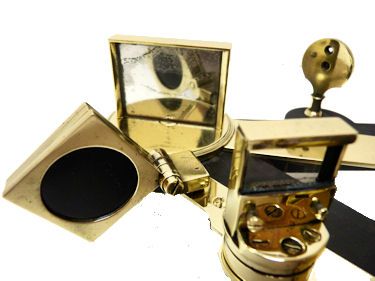
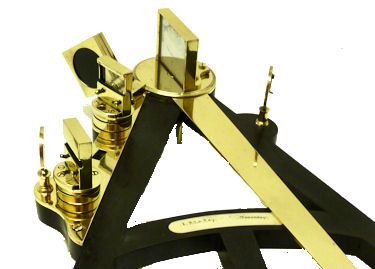
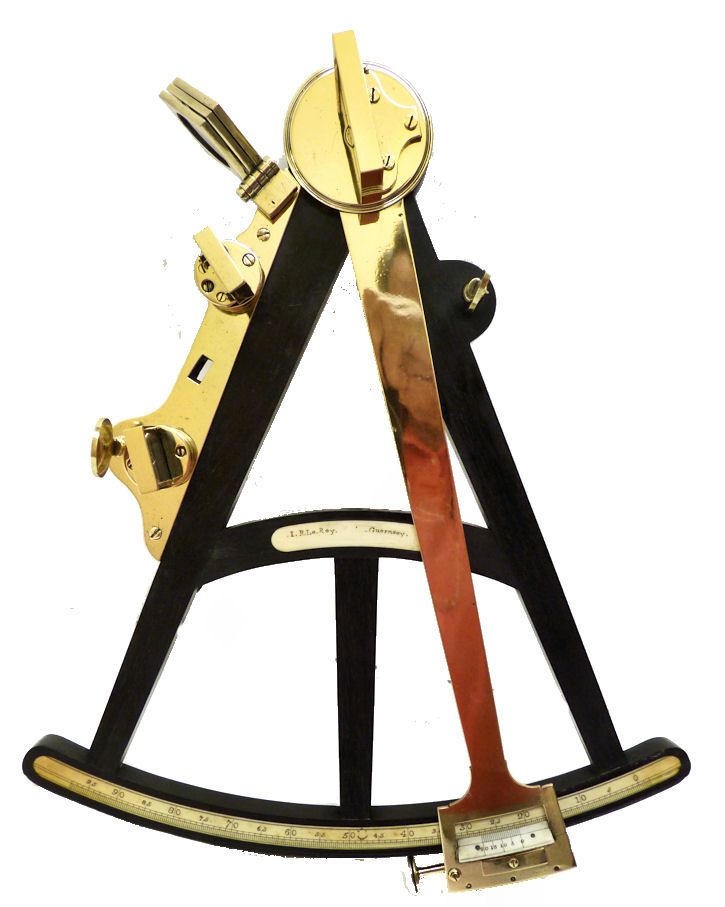
is a mariner's octant made during the first half of the 18th Century. It is fitted with two horizon
mirrors and two peep sights, the lower set being for taking “back sights“. It has the highly desirable
imprint of a partial anchor with initials on either side on the arc between 45°; and 50° which is known to be that of Jessie
Ramsden, one of England's foremost instrument makers. Jesse Ramsden invented the dividing machine allowing
for the precision marking of degrees on an instrument's arc in 1775 and also made these arcs for others. The accuracy
and sharpness of the arc's numerals suggest that this instrument was made by an advanced instrument maker, one who would
stand at the top of his trade. It has been polished and lacquered to be suitable for presentation as an important gift.
|
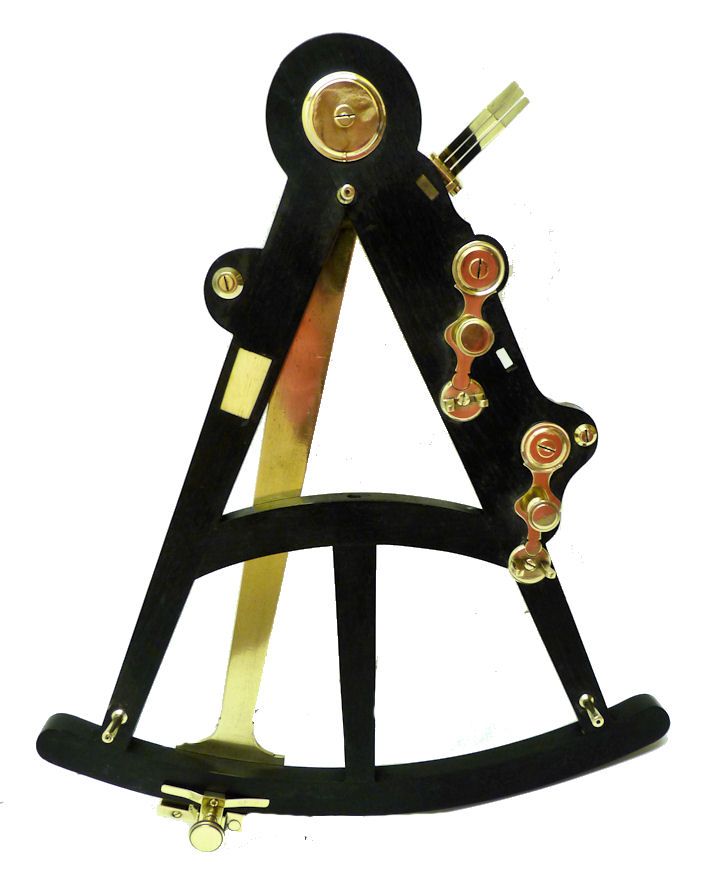
The back shows the complex machined parts of the instrument |
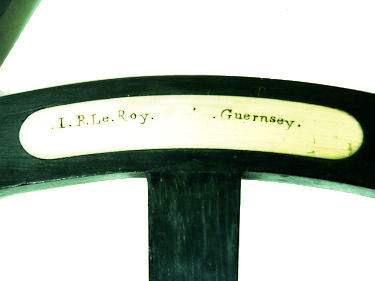
This octant is marked J.B. Le Roy on the crossbar with
the name listed in Webster's Database of Instrument makers with only one example dating to 1820. The instrument is 13 3/4 inches on the vertical which is still oversize for octants,
but smaller than the typical Hadley style octant of 17“. It was Hadley that invented the "double reflecting"
principal introducing it to the Royal Society in London in 1731.
It is
in its natural state with a mellow patina of age that has developed over the last 216 years and is remarkably well
preserved considering age and use at sea. Please read the Condition Statement for details.
The
original ivory cross member ivory is marked, I.B. Le Roy, Guernsey
JESSE RAMSDEN, ONE OF ENGLAND'S MOST IMPORTANT INSTRUMENT MAKER'S HISTORY: Jesse Ramsden
(1735-1800)
Ramsden was one of the most famous English scientific-instrument makers of the second half of the eighteenth century. In
1775, he invented a semi-automatic dividing machine, capable of marking graduated scales on sextants and other nautical and
astronomical instruments for his own instruments and provided the same to other mathematical instrument makers. He developed
improvements in the manufacture of sextants, theodolites, barometers, micrometers, and countless other devices. One of the
most important instruments built by him is the great astronomical circle of the Palermo Observatory. In 1786, elected fellow
of the Royal Society of London and, eight years later, member of the Imperial Academy of Saint Petersburg. In 1795, won the
Copley Medal, the highest scientific award of his time: the prize was established in 1736 by the Royal Society, thanks to
a bequest from Sir Godfrey Copley.
|
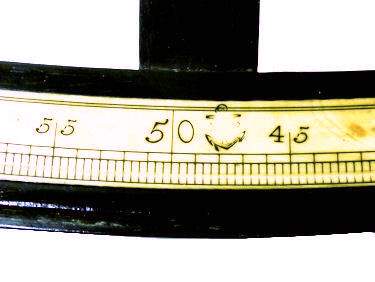
Arc - engraver's mark between 50° & 45° |
MARKINGS: You can clearly see the flukes of an anchor between 45 and 50 degree position on
the arc. With the aid of a loupe you can make out an initial on either side of the anchor. This mark is best known as
that of Jessie Ramsden. Ramsden is the English instrument maker who invented the dividing machine which allowed
for the precision indexing of degrees on an instrument's arc.
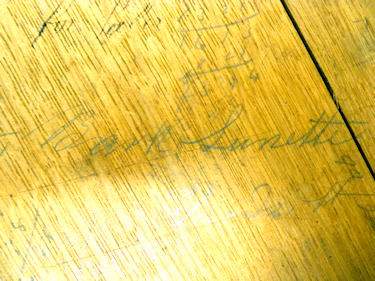
Inside the
case are eight notations in pencil which solve Local Apparent Noon sights for latitude. In addition is, “Bark
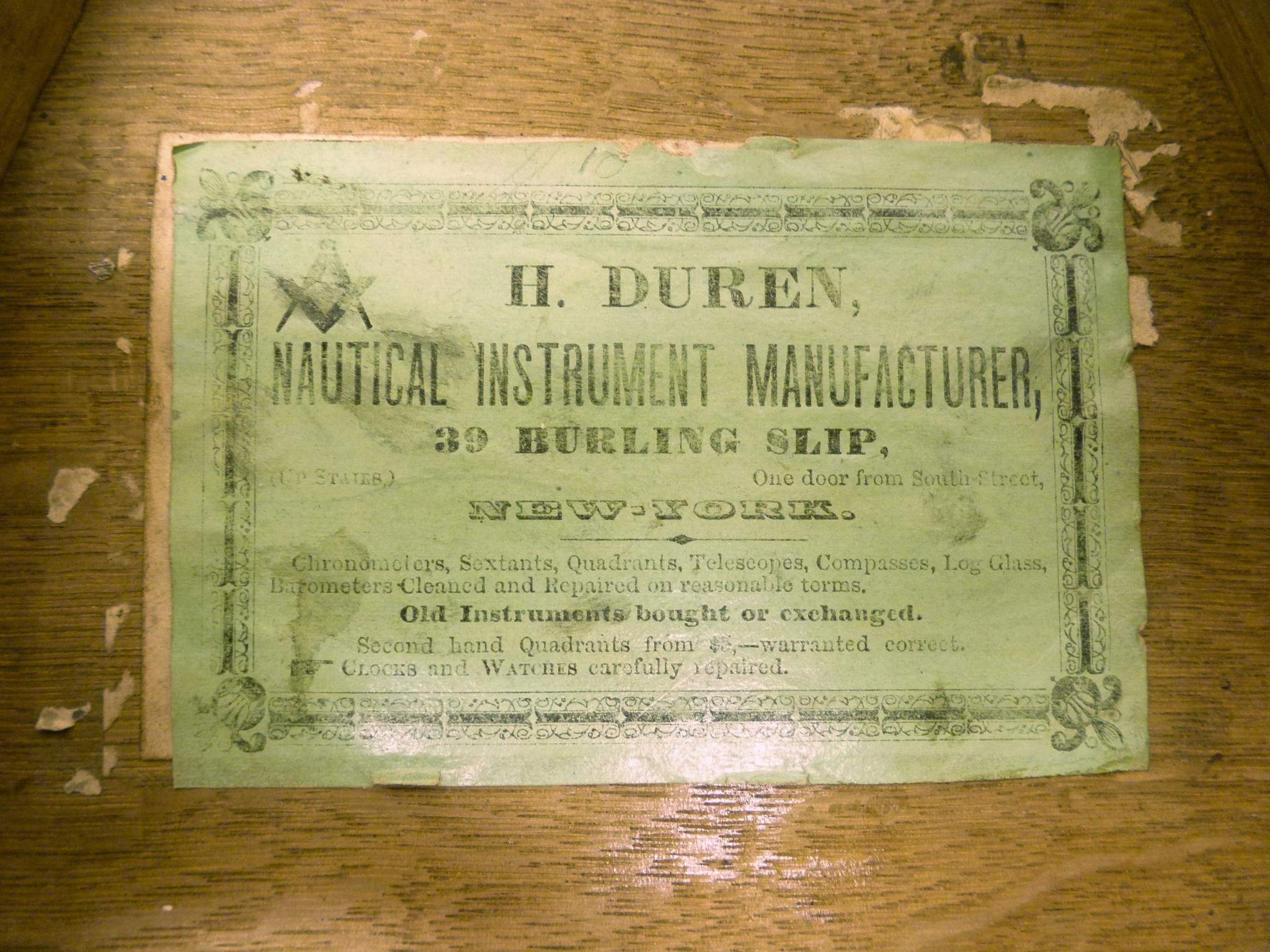
Sunette“, and the name of the master which is illegible. There also is an H. Duren, 39 Burling Slip,
New York, instrument maker's label. Duren was active there in the 1850's, but this octant, made in England, predates
that by a wide margin.
|
Sighting machinery looking backward | |
|
Sighting machinery looking up | |
|
DATING
THE INSTRUMENT: The ivory arc measures from - 5 to plus 95 degrees
on a Ebony frame which is in excellent condition. It is known that Mahogany went out of use in favor of Ebony some time
after 1750. The octant has a flat brass index arm without a stiffening brace that measures 13 3/4 inches
to the bottom of the index arm. Tangent screws began replacing finger clamps in the last quarter of the 18th Century. There are two horizon mirrors, each mounted on an adjustable turntable where
the base can be rotated by loosening a screw which locks the mirror's position. There is a single set of three shades
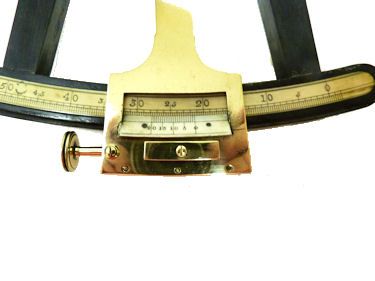
which may be moved from the upper to lower position. The ivory vernier scale, reads from right to left from 20 to 0 arc minutes.
There are two peep sights. The adjustable tangent screw, followed the use of the index arm clamp which ended around
the last quarter if the 1700's.
All of these
features date the instrument after 1750 and before 1800. See Peter Ifland's
comprehensive sextant work, "Taking the Stars". particularly figure 64, page 57.
|
Old style vernier reading from 0 at right | |
|
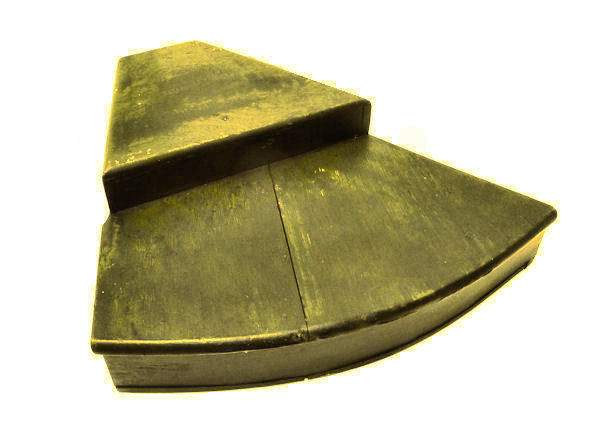
Period stair step keystone case | |
|
|
CONDITION: The instrument is in excellent condition. The graduated arc, and all its hardware
are in working order. All three bronze legs are original. It is missing the original ivory pencil
on the cross bar as are most instruments of this age. All three mirrors have most of their silvering, but show
their age. The machinery is all present and the shades are intact.
The Case is the early
style “stair step“, keystone design of this period. Both the top and bottom have age cracks, but everything is
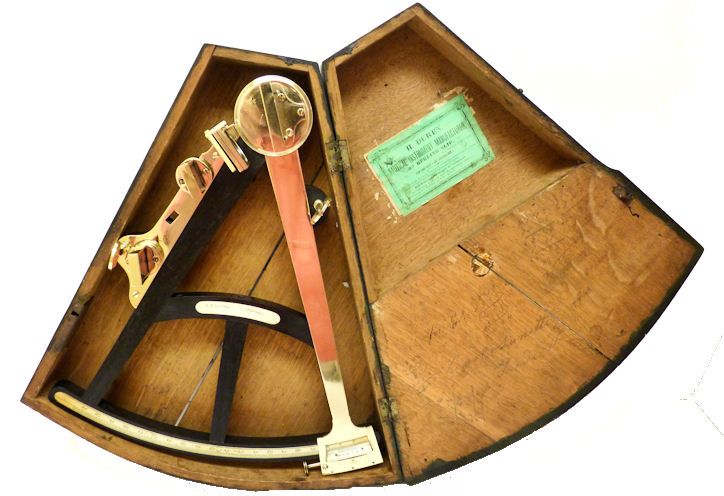
secure. The inside has an H. Duren, 39 Burling Slip, New York, instrument maker's label pasted over the remnants
of a second label. There numerous pencil notations in the inside which are discussed under markings. It is
strong and sturdy, and the octant fits as it should. There are a number of different coats of paint in Colonial greens. There
is a lock, but no no key.
|
Instrument in case. Note label and age cracks |
All in all,
a rare, desirable, and special example of an early Hadley style octant .
DIMENSIONS:
-
Arc reads - 5 to +95 degrees
-
Length of index arm 13 3/4" long
-
Width of frame at arc 11 1/4 " wide
-
Index mirror 43 x 32 mm
-
Horizon mirror - 27 x 18 mm
-
Back sight mirror - 27 x 18 mm
-
Three movable shade glasses
-
Two Peep sights
-
Weight octant 2 Lbs 9 oz
OUR QUALIFICATIONS: We are one of the few company's still selling navigation instruments that know anything


about them. For purposes of judging whether Joel's opinion counts, he was the editor of the chapter on sextants
of the 1977 Edition of "Bowditch", The American Practical Navigator, NAVPUB 9; a member of the U.S. Naval Academy Navigation
Symposium Board, 1975 -1978; the author of a book on marine sextants, Cornell Maritime Press,1975, and the founding president
of Nautech Maritime Corporation which partnered with Tamaya of Japan in the introduction of the MS 733 Spica, the MS 833,
Jupiter, MS 933 Venus sextants and the famous NC-2 navigation computer, in the U.S. market. Joel is also a retired Master
Upon Oceans, and held a U.S. Navy "D" Qualification as a Senior Skipper - Oceans.
From 1995 through 2000, he served as a Varsity Offshore Sailing Team coach at the U.S. Naval Academy.
SHIPPING
& INSURED PACKING byFedEx Ground to the 48 contiguous States,$50.00
OUR
UNCONDITIONAL NO NONSENSE GUARANTEE: If not completely satisfied with your purchase it may be returned within five
days of receipt in its original packaging if without damage. Return items must be insured for their full value. Only a prior
email authorization from us for the return is required. Shipping charges are included in this offer within the continental
United States if an error is due to our fault.
International buyers welcome, but inquire first. We have
satisfied customers in Argentina, Australia, Austria, Belgium, Bermuda,
British Virgin Islands, Canada, Chile, Republic of China, Czech Republic, Democratic Republic of Congo, Denmark, Estonia,
England, France, Germany, Greece, Holland, Hong Kong, Hungary, Iceland, Indonesia, Ireland, Israel, Italy, Japan, Kuwait,
Latvia, Luxembourg, Malaysia, Martinique, Mexico, New Zealand, Nigeria, Norway, Nova Scotia, Panama, Philippines, Poland,
Portugal, Puerto Rico, Romania, Russia, Saudi Arabia, Scotland, Singapore, South Africa, Spain, St. Maarten, Sweden, Switzerland,
Thailand, Turkey, United Arab Emirates, USVI and the Eastern Caribbean.
ACCEPTED
FORMS OF PAYMENT are Bank wire transfer, cashier's check, or personal check in which case the item will be held until
cleared. Our prices are quoted net to seller, but credit cards may be accepted through PayPal for verified members
by special arrangement.
This early octant is a special
find for someone who appreciates a rare 18th Century instrument.
Copyright 2013 - 2011 by Land And Sea Collection™, All Rights Reserved |
|
 |
|
|
 |
|
|
 |
|
|
|
|
|
|
 |
 |
|