Land and Sea Collection Nautical, Marine Antiques & Marine Art, Dive Helmets, Ship Models, Sextants
Antique Three Ring ( Dreikreis) C. Plath Quintant - Sextant Ca 1900 Very Rare
Very Rare C. Plath Early 20th Cent THREE CIRCLE (Dreikreis) QUINTANT/SEXTANT Rare three circle quintant by C. Plath, Hamburg, Ca 1900 Presented is an antique quintant, meaning a sextant having a range of 144°, or an arc of 72°. It was made by C. Plath of Hamburg, Germany, around the Turn of the 20th Century. It has one of their rarely seen three circle (Dreikreis) frames. In fact, this is only the second of this type that we've offered for sale making it ideal for the serious collector. See http://landandseacollection.com/id136.html It comes with a star scope, a collimation scope and a sighting tube for shooting terrestrial objects.Based on our proprietary register of C. Plath instruments' serial numbers which dates back to 1895, and earlier if we include those made directly after Plath's purchase of the David Filby company in 1862, and the inclusion of a similar three ring design, but with micrometer drum in a 1902 catalog, we date it to be Ca 1900. This compares favorably with serial number 7777 which, four years ago, we estimated to have been made in 1910. That one was originally made as a surveying (Vermessung) instrument without shades (filters) and was purpose built to measure angles both on land and at sea, for doing surveys, making nautical charts or setting navigation aides. This is established by its arc which reads to 150 degrees rather than the customary 120 degrees for a sextant. Instruments designed for this purpose were not fitted with shade glasses so the ones installed here were fitted later as was the micrometer drum. This is not so with this earlier example which clearly was made as a vernier quintant with shades. SN 6270 over early “Stick Man“ logo Adjustable rising piece. A worthwhile feature Horizon mirror has one cracked shade Perfect index mirrorCONDITION: Except for a few minor faults, the quintant is in exceptionally fine condition having about ninety five percent of its original lacquered, mid-night black, finish remaining. The same holds true of the original varnish on the three telescopes. It shows very little corrosion of its bronze parts and elsewhere it is in like new condition. The index mirror is clear, sharp and without blemish. The horizon mirror shows the affects of salt spray. The interior horizon shade is cracked, but tight in its frame and still usable. The tangent screw shaft has a slight bend, but is functional. The Ebony handle provides a nice contrast to the metal work. The mirror adjustment tool is a replacement.The bronze arc is calibrated -5 to 155+ degrees with a vernier that reads from the right, from 0 to 1 minute of arc, and can be estimated to one sixth minute. Serial Number 6270 is imprinted to the right upper side of the arc and just above an old style “Stick Man“ logo. Normally, you would expect to find that on the arc's left terminus. The sextant has four index shades and three horizon shades.THE CASE: The instrument is housed in a fitted wood carrying case with brass hardware. There is no key for the lock. Inside is a plate with the Plath logo and an address at 25 Stubbenhuk 25, Hamburg. The case is in excellent strong condition with a nice patina of age to its varnish finish. This does not affect its integrity, only its looks. There might be a rag ors a brush missing. This is only the second C.Plath three circle quintant/sextant we have ever seen. They are not even pictured in the definitive work on the topic of sextants, "Taking the Stars" by Dr. Peter Ifland. It will make a rare addition to an important collection or as a gift of importance. Handsome hardwood case Lower view of frame OUR QUALIFICATIONS: We are one of the few company's still selling navigation instruments that know anything about them. For purposes of judging whether Joel's opinion counts, he was the editor of the chapter on sextants of the 1977 Edition of "Bowditch", The American Practical Navigator, NAVPUB 9; a member of the U.S. Naval Academy Navigation Symposium Board, 1975 -1978; the author of a book on marine sextants, Cornell Maritime Press,1975, and the founding president of Nautech Maritime Corporation which partnered with Tamaya of Japan in the introduction of their sextants and the famous NC-2 navigation computer, in the U.S. market. Joel is also a retired Master Mariner, and held a U.S. Navy "D" Qualification as a Senior Skipper - Oceans. From 1995 through 2000, he served as a Varsity Offshore Sailing Team coach at the U.S. Naval Academy. This quintant is an outstanding example of an elegant Plath three circle frame model and rates 5 Plus Stars. Ca 1902 C. Plath catalog page showing Surveying model with micrometer drum. Please scroll down for gallery photos! SPECIFICATIONS: CASE 11 1/4" x 11 1/4" L x 5 1/2" W QUINTANT / SEXTANT: Star scope Collimation scope Sighting tube Length of index arm 9 1/4" Width of arc 10 1/2" Diameter 1 circle 2 1/2" ID Index Mirror 47 mm x 30 mm Horizon Mirror 32 mm x 22 mm SEXTANT WEIGHT 3 lbs 9 oz FLAT RATE SHIPPING to 48 contiguous States $59.50OUR UNCONDITIONAL NO NONSENSE GUARANTEE: If not completely satisfied with your purchase it may be returned within five days of receipt in its original packaging if without damage. Return items must be insured for their full value. Only a prior email authorization from us for the return is required. Shipping charges are included in this offer if an error is due to our fault. International buyers welcome, but you please contact first. We have satisfied customers in Argentina, Australia, Austria, Belgium, Bermuda, British Virgin Islands, Canada, Chile, China, Czech Republic, Democratic Republic of Congo, Denmark, Estonia, England, France, Germany, Greece, Holland, Hong Kong, Hungary, Iceland, Ireland, Israel, Italy, Japan, Kuwait, Latvia, Malaysia, Martinique, Mexico, New Zealand, Norway, Nova Scotia, Panama, Poland, Portugal, Puerto Rico, Romania, Saudi Arabia, Scotland, Singapore, Spain, Sweden, Switzerland, Thailand, Turkey, United Arab Emirates, USVI and the Eastern Caribbean. ACCEPTED FORMS OF PAYMENT are Bank wire transfer, cashier's check, money order, or personal check in which case the item will be held until cleared. No credit cards or PayPal accepted on this item. Copyright 2010 by Land And Sea Collection™, All Rights Reserved Image Gallery Hosted By MyEasyPics.com
Rare three circle quintant by C. Plath, Hamburg, Ca 1900 Presented is an antique quintant, meaning a sextant having a range of 144°, or an arc of 72°. It was made by C. Plath of Hamburg, Germany, around the Turn of the 20th Century. It has one of their rarely seen three circle (Dreikreis) frames. In fact, this is only the second of this type that we've offered for sale making it ideal for the serious collector. See http://landandseacollection.com/id136.html It comes with a star scope, a collimation scope and a sighting tube for shooting terrestrial objects.Based on our proprietary register of C. Plath instruments' serial numbers which dates back to 1895, and earlier if we include those made directly after Plath's purchase of the David Filby company in 1862, and the inclusion of a similar three ring design, but with micrometer drum in a 1902 catalog, we date it to be Ca 1900. This compares favorably with serial number 7777 which, four years ago, we estimated to have been made in 1910. That one was originally made as a surveying (Vermessung) instrument without shades (filters) and was purpose built to measure angles both on land and at sea, for doing surveys, making nautical charts or setting navigation aides. This is established by its arc which reads to 150 degrees rather than the customary 120 degrees for a sextant. Instruments designed for this purpose were not fitted with shade glasses so the ones installed here were fitted later as was the micrometer drum. This is not so with this earlier example which clearly was made as a vernier quintant with shades. SN 6270 over early “Stick Man“ logo Adjustable rising piece. A worthwhile feature Horizon mirror has one cracked shade Perfect index mirrorCONDITION: Except for a few minor faults, the quintant is in exceptionally fine condition having about ninety five percent of its original lacquered, mid-night black, finish remaining. The same holds true of the original varnish on the three telescopes. It shows very little corrosion of its bronze parts and elsewhere it is in like new condition. The index mirror is clear, sharp and without blemish. The horizon mirror shows the affects of salt spray. The interior horizon shade is cracked, but tight in its frame and still usable. The tangent screw shaft has a slight bend, but is functional. The Ebony handle provides a nice contrast to the metal work. The mirror adjustment tool is a replacement.The bronze arc is calibrated -5 to 155+ degrees with a vernier that reads from the right, from 0 to 1 minute of arc, and can be estimated to one sixth minute. Serial Number 6270 is imprinted to the right upper side of the arc and just above an old style “Stick Man“ logo. Normally, you would expect to find that on the arc's left terminus. The sextant has four index shades and three horizon shades.THE CASE: The instrument is housed in a fitted wood carrying case with brass hardware. There is no key for the lock. Inside is a plate with the Plath logo and an address at 25 Stubbenhuk 25, Hamburg. The case is in excellent strong condition with a nice patina of age to its varnish finish. This does not affect its integrity, only its looks. There might be a rag ors a brush missing. This is only the second C.Plath three circle quintant/sextant we have ever seen. They are not even pictured in the definitive work on the topic of sextants, "Taking the Stars" by Dr. Peter Ifland. It will make a rare addition to an important collection or as a gift of importance.
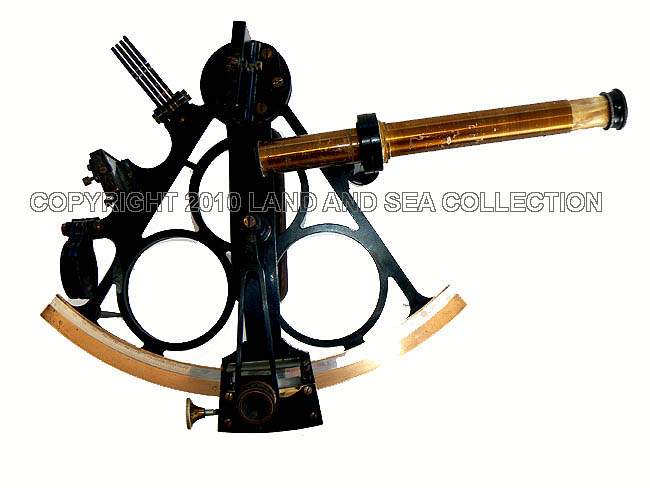
Presented is an antique quintant, meaning a sextant having a range of 144°, or an arc of 72°. It was made by C. Plath of Hamburg, Germany, around the Turn of the 20th Century. It has one of their rarely seen three circle (Dreikreis) frames. In fact, this is only the second of this type that we've offered for sale making it ideal for the serious collector. See http://landandseacollection.com/id136.html It comes with a star scope, a collimation scope and a sighting tube for shooting terrestrial objects.Based on our proprietary register of C. Plath instruments' serial numbers which dates back to 1895, and earlier if we include those made directly after Plath's purchase of the David Filby company in 1862, and the inclusion of a similar three ring design, but with micrometer drum in a 1902 catalog, we date it to be Ca 1900. This compares favorably with serial number 7777 which, four years ago, we estimated to have been made in 1910. That one was originally made as a surveying (Vermessung) instrument without shades (filters) and was purpose built to measure angles both on land and at sea, for doing surveys, making nautical charts or setting navigation aides. This is established by its arc which reads to 150 degrees rather than the customary 120 degrees for a sextant. Instruments designed for this purpose were not fitted with shade glasses so the ones installed here were fitted later as was the micrometer drum. This is not so with this earlier example which clearly was made as a vernier quintant with shades. SN 6270 over early “Stick Man“ logo Adjustable rising piece. A worthwhile feature Horizon mirror has one cracked shade Perfect index mirrorCONDITION: Except for a few minor faults, the quintant is in exceptionally fine condition having about ninety five percent of its original lacquered, mid-night black, finish remaining. The same holds true of the original varnish on the three telescopes. It shows very little corrosion of its bronze parts and elsewhere it is in like new condition. The index mirror is clear, sharp and without blemish. The horizon mirror shows the affects of salt spray. The interior horizon shade is cracked, but tight in its frame and still usable. The tangent screw shaft has a slight bend, but is functional. The Ebony handle provides a nice contrast to the metal work. The mirror adjustment tool is a replacement.The bronze arc is calibrated -5 to 155+ degrees with a vernier that reads from the right, from 0 to 1 minute of arc, and can be estimated to one sixth minute. Serial Number 6270 is imprinted to the right upper side of the arc and just above an old style “Stick Man“ logo. Normally, you would expect to find that on the arc's left terminus. The sextant has four index shades and three horizon shades.THE CASE: The instrument is housed in a fitted wood carrying case with brass hardware. There is no key for the lock. Inside is a plate with the Plath logo and an address at 25 Stubbenhuk 25, Hamburg. The case is in excellent strong condition with a nice patina of age to its varnish finish. This does not affect its integrity, only its looks. There might be a rag ors a brush missing.
This is only the second C.Plath three circle quintant/sextant we have ever seen. They are not even pictured in the definitive work on the topic of sextants, "Taking the Stars" by Dr. Peter Ifland. It will make a rare addition to an important collection or as a gift of importance.
Handsome hardwood case Lower view of frame OUR QUALIFICATIONS: We are one of the few company's still selling navigation instruments that know anything about them. For purposes of judging whether Joel's opinion counts, he was the editor of the chapter on sextants of the 1977 Edition of "Bowditch", The American Practical Navigator, NAVPUB 9; a member of the U.S. Naval Academy Navigation Symposium Board, 1975 -1978; the author of a book on marine sextants, Cornell Maritime Press,1975, and the founding president of Nautech Maritime Corporation which partnered with Tamaya of Japan in the introduction of their sextants and the famous NC-2 navigation computer, in the U.S. market. Joel is also a retired Master Mariner, and held a U.S. Navy "D" Qualification as a Senior Skipper - Oceans. From 1995 through 2000, he served as a Varsity Offshore Sailing Team coach at the U.S. Naval Academy.
SPECIFICATIONS:
CASE 11 1/4" x 11 1/4" L x 5 1/2" W QUINTANT / SEXTANT: Star scope Collimation scope Sighting tube Length of index arm 9 1/4" Width of arc 10 1/2" Diameter 1 circle 2 1/2" ID Index Mirror 47 mm x 30 mm Horizon Mirror 32 mm x 22 mm SEXTANT WEIGHT 3 lbs 9 oz FLAT RATE SHIPPING to 48 contiguous States $59.50OUR UNCONDITIONAL NO NONSENSE GUARANTEE: If not completely satisfied with your purchase it may be returned within five days of receipt in its original packaging if without damage. Return items must be insured for their full value. Only a prior email authorization from us for the return is required. Shipping charges are included in this offer if an error is due to our fault.
International buyers welcome, but you please contact first. We have satisfied customers in Argentina, Australia, Austria, Belgium, Bermuda, British Virgin Islands, Canada, Chile, China, Czech Republic, Democratic Republic of Congo, Denmark, Estonia, England, France, Germany, Greece, Holland, Hong Kong, Hungary, Iceland, Ireland, Israel, Italy, Japan, Kuwait, Latvia, Malaysia, Martinique, Mexico, New Zealand, Norway, Nova Scotia, Panama, Poland, Portugal, Puerto Rico, Romania, Saudi Arabia, Scotland, Singapore, Spain, Sweden, Switzerland, Thailand, Turkey, United Arab Emirates, USVI and the Eastern Caribbean.
ACCEPTED FORMS OF PAYMENT are Bank wire transfer, cashier's check, money order, or personal check in which case the item will be held until cleared. No credit cards or PayPal accepted on this item. Copyright 2010 by Land And Sea Collection™, All Rights Reserved
ACCEPTED FORMS OF PAYMENT are Bank wire transfer, cashier's check, money order, or personal check in which case the item will be held until cleared. No credit cards or PayPal accepted on this item.
Copyright 2010 by Land And Sea Collection™, All Rights Reserved